DEPARTMENT OF UNNECESSARY MILITARY STATISTICS · FIELD REPORT 012
The Great Boot Camp Shitting Schedule
A logistical question: can an entire training company reach the same set of toilets before formation?
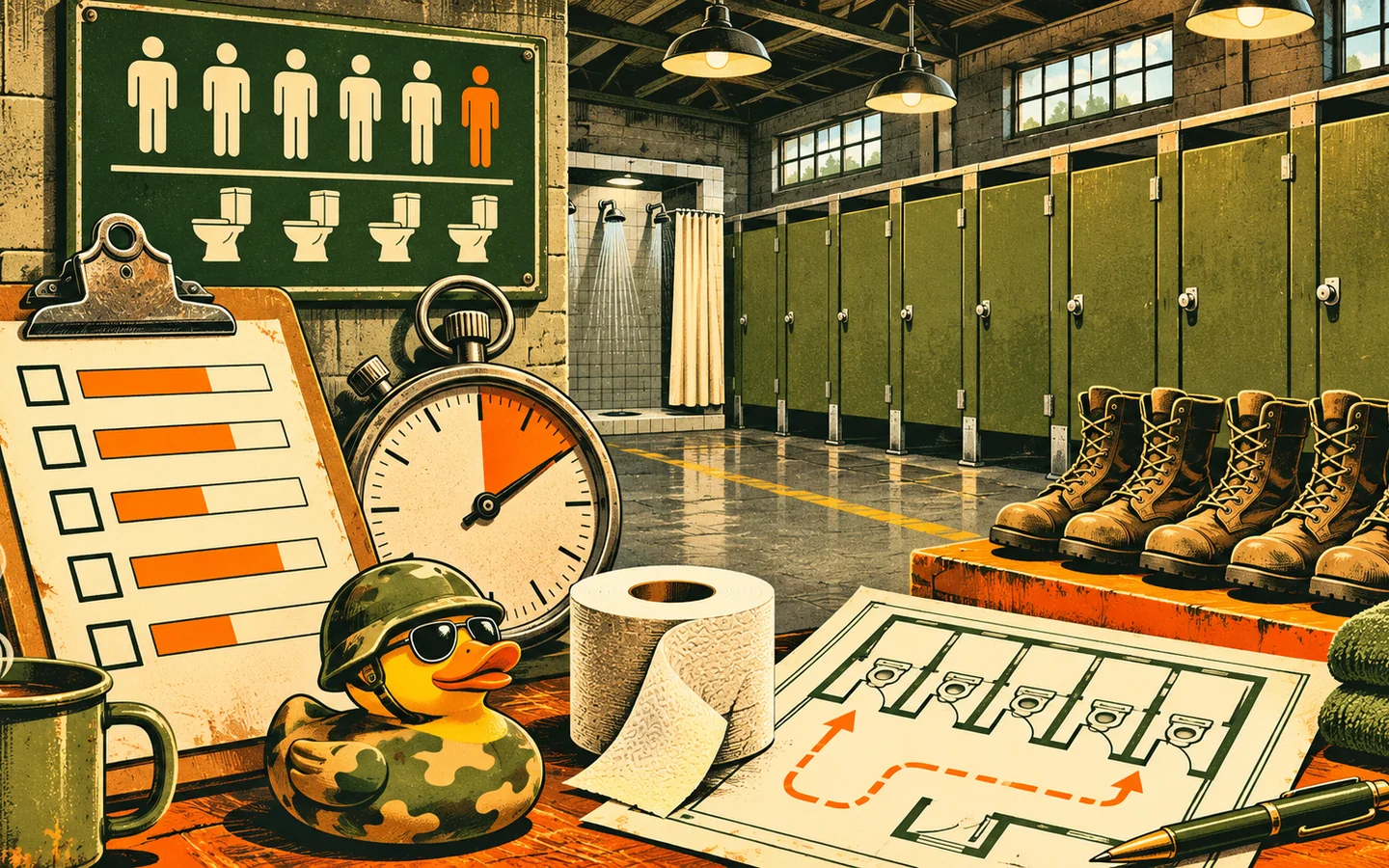
The great porcelain bottleneck
You have forty recruits, six toilets, an early formation and a clock that has started to sprint. Somewhere in that equation is an answer to a question that generals, admirals and an enormous number of nervous new recruits should have asked long ago: does the bathroom have enough throughput?
There is no dignified way to phrase this. Military organizations care about readiness, accountability, facility capacity and access to basic hygiene. Bathroom time is one of the mundane constraints hiding behind those large concepts. A training company may have plenty of enthusiasm. It cannot manufacture a seventh toilet out of discipline.
Our Department has therefore opened The Great Boot Camp Shitting Schedule, a strictly hypothetical investigation into the number of individual restroom visits that can fit inside a given window. We will use arithmetic, not actual recruits' bathroom habits, and we promise to stop before issuing a NATO latrine-capacity certification.
The architecture is not standardized across the force
It would be easy to write that every recruit faces exactly the same open-bay latrine, but it would also be wrong. Installations have been built and renovated in different eras. An Army historical account of Fort Leonard Wood barracks traces the evolution from large shared facilities toward more private arrangements. The Marine Corps study of recruit training likewise describes differences in squad-bay layout and privacy practices.
That means we can't confidently publish “average toilets per recruit” for the entire U.S. military from those documents, let alone a branch-by-branch bowel-movement probability. The responsible thing is to treat the calculator as a made-up scheduling problem with inputs the reader can change. We can laugh at the bottleneck without pretending we measured the digestive systems of 100,000 people.
How the bottleneck actually works
Suppose twenty-four people need an individual facility, four stalls are available and each visit, including transition, takes four minutes. If everyone must finish in a twelve-minute window, each stall can accommodate three people—twelve visits total. The model says the queue is only halfway processed. The rest of the class may be physically fit enough to run five miles, but the latrine cannot violate arithmetic.
The model is intentionally crude. Real use varies; people arrive at different times, the duration of a visit is unpredictable, not everybody needs the same facility, and actual scheduling includes alternative times and accommodations. Nobody should interpret the output as military policy or pressure someone to rush a medical need. The toy problem is about capacity and time, not evaluating bodies.
Our imaginary solutions office has proposed three interventions: triple the stalls, triple the time or appoint a Private First Class to shout “MOVE WITH PURPOSE” at a wall. Only the first two can improve the mathematical throughput. The third is administratively cheaper.
Introducing the Latrine Throughput Simulator
Enter a hypothetical population, number of available stalls, total available minutes and average time per visit. The tool shows theoretical maximum completed visits, the unserved portion of the queue and the minimum number of minutes needed at the chosen assumptions.
The formula is simple enough to fit on a napkin, which is fortunate because the Department's supply closet has run out of PowerPoint licensing seats. We recommend using the tool to illustrate capacity—not to establish personal health expectations or a rule that anyone should delay going to the bathroom.
What the General Staff should learn
The truly serious point is that hygiene and restroom access are basic operational needs, not optional rewards. The Parris Island recruit-training order calls for time to address personal hygiene and daily shower requirements, not a doctrine of denying people access when they need it. A simplistic calculator is no replacement for actual planning, dignified facilities and sensible supervision.
The Department's final judgment is therefore as follows: if forty people must use four stalls in the same ten minutes, the problem is probably not a lack of motivation. It may simply be four stalls.
Department verdict: Insufficient infrastructure cannot be corrected through superior yelling. Request additional porcelain, additional minutes or both. Submit in triplicate.
Primary and contextual sources
Sources document the underlying policy, physiology or facility context. They do not prove the jokes, the modeled inputs, or a national branch ranking.
More from the Department of Personal Equipment
The Personal Equipment Bureau · Penis Census · Operation Blue Balls · Pube Maintenance Crisis · Five-Minute Shower Doctrine
Operation Golden Sample · Morning Wood Readiness Crisis · Boot Camp Shitting Schedule