DEPARTMENT OF UNNECESSARY MILITARY STATISTICS · FIELD REPORT 010
Operation Golden Sample: A Military Career in Watching Other Men Pee
The military has formal rules for direct observation, specimen custody, signatures and labels. We submit an entirely unsolicited observer-duty cost analysis.
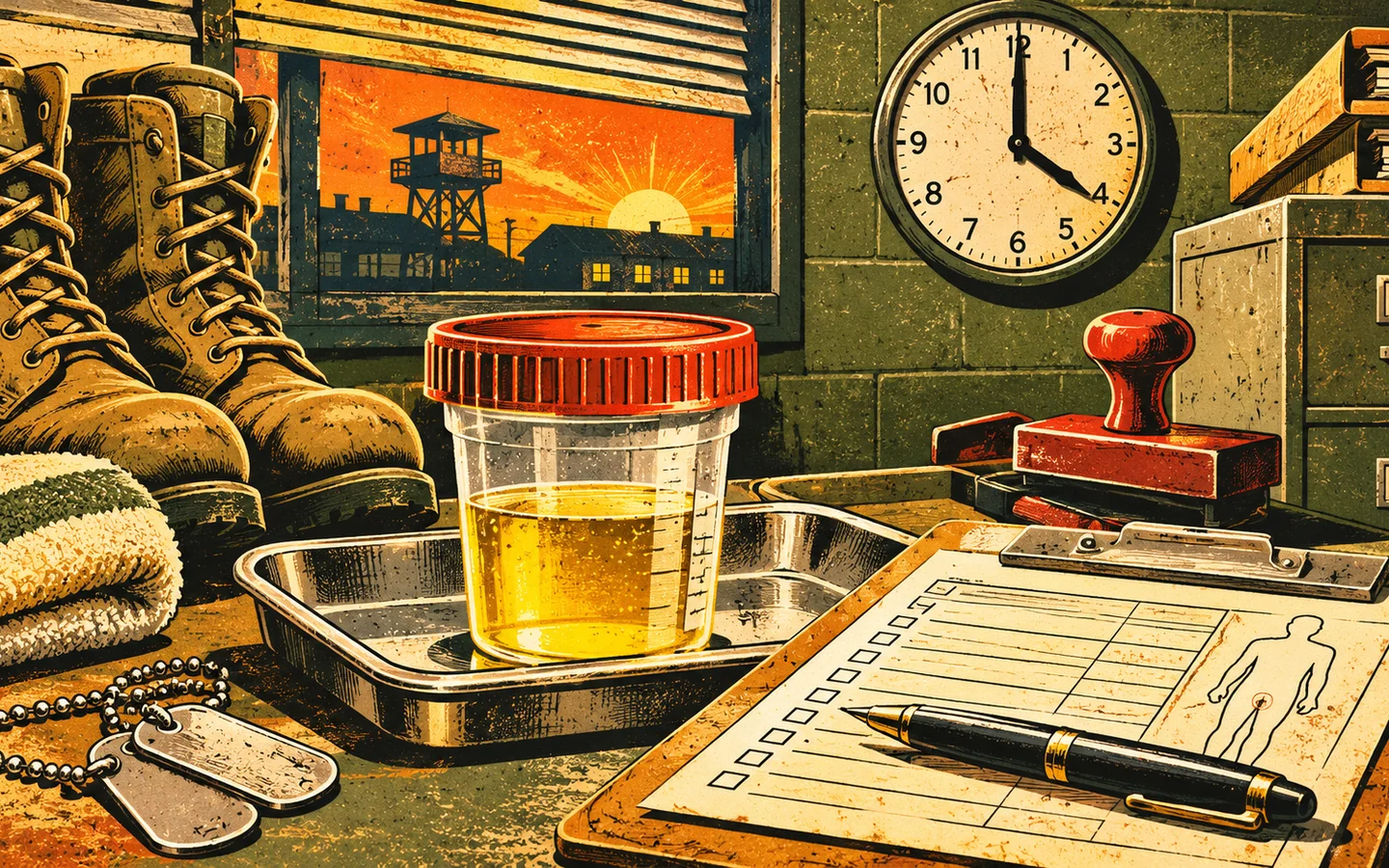
The least glamorous occupational specialty nobody asked for
Imagine reporting for duty and learning that today's operational objective is to watch somebody produce a urine sample. Not metaphorically. Not as a figure of speech. The mission involves an actual specimen bottle, an observer, a chain-of-custody form, and the kind of documentation normally associated with transferring nuclear launch codes.
Welcome to Operation Golden Sample, an official-sounding field report from the Department of Unnecessary Military Statistics. We did not invent the awkward premise. We only invented the department, the paperwork budget, and the ceremonial rubber duck.
The joke works because there is real policy underneath it. Department of Defense Instruction 1010.16, updated August 22, 2025 says urine specimens are collected under direct observation by a designated, properly trained person whose DEERS sex marker matches that of the person providing the specimen. It also explains that commanders may take additional steps to protect privacy, as long as they do not undermine the integrity of collection.
What the rule actually says
Section 4 of the instruction is less an invitation to awkward small talk than a detailed effort to prevent substitution, adulteration and mishandling. The instruction requires a clear view of the specimen leaving the body and entering the bottle; it also specifies identity checks, labels, signatures and tamper-evident sealing. Military Departments establish their own event procedures for quotas, scheduling and staffing.
Those are documented requirements. We do not know how many observed collections a typical junior service member supervises in a four-year enlistment, how often each individual is selected for observer duty, or what a branch-by-branch “average exposure” might be. You can model a unit schedule, but you cannot convert a fictional schedule into a military population statistic.
The great irony is that the military has a documented procedure precisely because it takes specimen integrity seriously. What reads like a comedy sketch is, at base, an accountability procedure with some unusually personal consequences.
A six-step mission in search of a glamorous name
Our fictional office has assigned each step a dramatic code name: (1) Operation Locate the Bottle, (2) Operation Confirm the Name, (3) Operation Stand There Awkwardly, (4) Operation Confirm the Collection, (5) Operation Sign the Thing, and (6) Operation Put the Thing in Another Thing. Those names are ours; the actual program is neither an improv show nor a spectator sport.
The first lesson for new observers is that an official procedure can require seriousness even when the circumstances are absurd. The second is that government forms have an astonishing ability to reproduce. A bottle is not administratively real until a form knows where it is. A form is not real until somebody signs it. A signature is not real until somebody checks that it was signed in the designated signature location. This is how a cup becomes a supply-chain event.
We consulted our imaginary Deputy Assistant Undersecretary for Sudden Silence. The response, allegedly drafted on a 47-page form, was: “The Department declines to comment on the Department's willingness to comment.”
Introducing the Observer-Duty Paperwork Calculator
We built a calculator for the part that can actually be counted: hypothetical staffing time. You choose a unit population, the number scheduled for testing, the number of trained observers available and the estimated minutes per collection. It estimates work-hours and the minimum time needed if everyone processes at the assumed rate.
It does not calculate a person's genital observations, does not claim actual testing frequencies and does not interpret regulations for an actual command. The default values are fictional. Their purpose is to answer the question nobody put on a command briefing slide: how many hours does the room have to remain aggressively professional?
The final unofficial finding
A soldier can be trusted with expensive equipment, sophisticated radios and classified information. Some must also be trusted with the deeply unglamorous responsibility of making sure a specimen is produced, labeled and documented correctly. This is less a contradiction than a reminder that organizations run on uncelebrated tasks.
Our recommendation is not to make the process silly while it is happening. We recommend saving the jokes for later, respecting the privacy and dignity of the people involved, and perhaps making a separate commemorative patch that is never, under any circumstances, worn in public.
Department verdict: Administratively necessary. Comedically inexhaustible. Properly observed, properly logged, and hopefully never introduced as the highlight of a recruiting advertisement.
Primary and contextual sources
Sources document the underlying policy, physiology or facility context. They do not prove the jokes, the modeled inputs, or a national branch ranking.
More from the Department of Personal Equipment
The Personal Equipment Bureau · Penis Census · Operation Blue Balls · Pube Maintenance Crisis · Five-Minute Shower Doctrine
Operation Golden Sample · Morning Wood Readiness Crisis · Boot Camp Shitting Schedule