The Department of Bodily Readiness
Three small problems, seven subcommittees, and absolutely no available bathrooms.
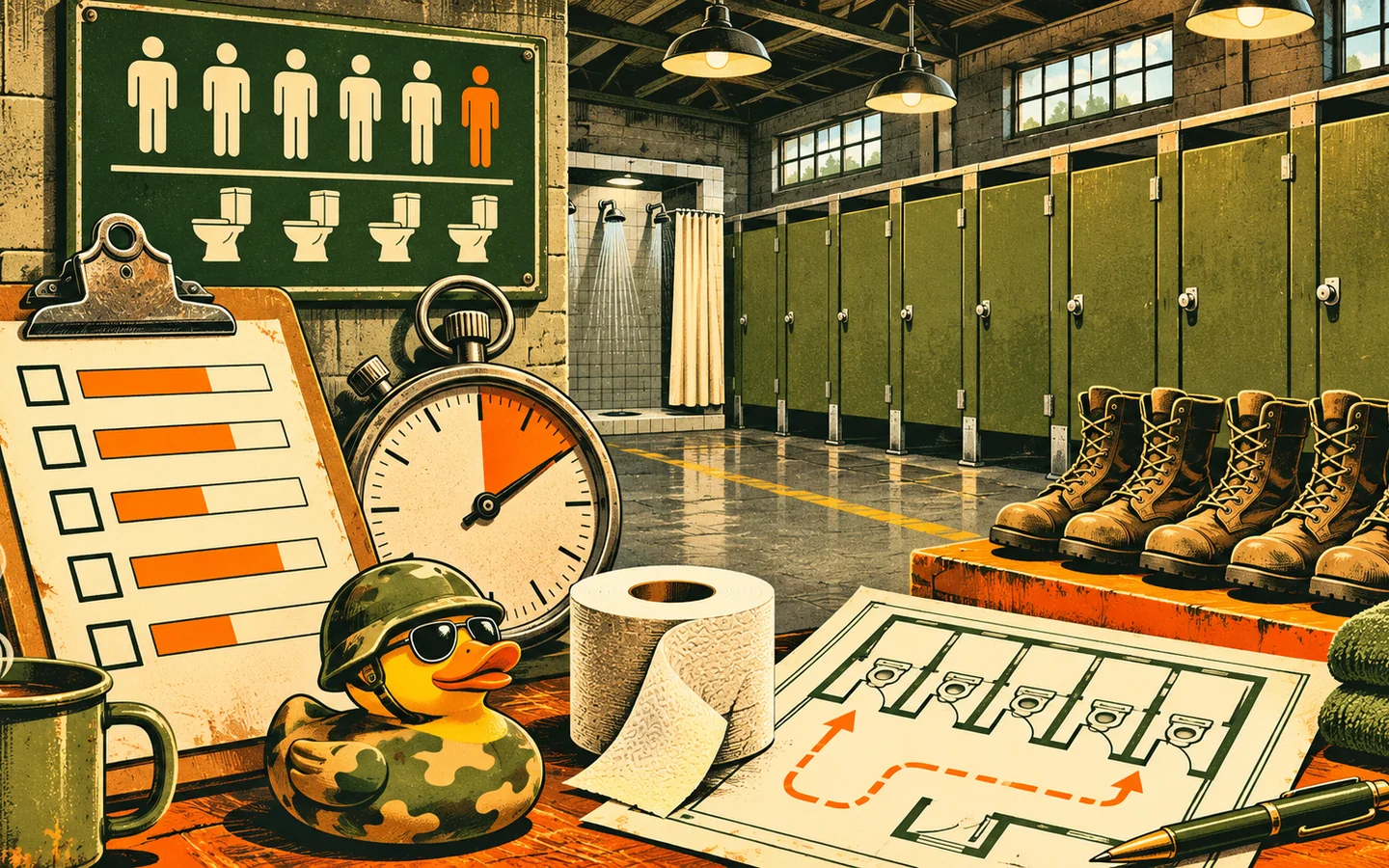
Chapter Annex: The Department of Bodily Readiness
When the Bureau first received a request to investigate three ordinary morning problems, it did what every competent institution does: it created a fourth problem to coordinate them.
The original memorandum contained only three questions. Who would watch the urine samples? How would recruits get dressed on time? And could forty people use six toilets without somebody missing formation? The Deputy Undersecretary of Personal Equipment, who had never been in a barracks and had once mistaken a canteen for a portable printer, immediately established a task force.
The task force needed a name. A name required a mission statement. A mission statement required a seal. A seal required a procurement office. By Tuesday afternoon, the group had seventeen members, six subcommittees, a 30-page charter, a ceremonial rubber duck and no answer to any of the questions.
Division One: The Cup and Its Journey
The Observer Operations Division convened at 0500, a time chosen to demonstrate seriousness rather than accommodate the human bladder. Its director unveiled a flowchart titled THE TRIUMPH OF THE SPECIMEN. There were so many arrows that the chart appeared to describe an aircraft carrier's propulsion system. A single bold red arrow indicated the exact moment at which somebody should stop asking questions and find a bottle.
“We must preserve chain of custody,” the director announced. The room nodded gravely. “We must confirm the label.” The room nodded again. “And we must never forget the moral courage required to stand around and complete an unpleasant but necessary task.” At this, the room looked toward the door, which turned out to be locked for the duration of the mandatory briefing.
Division Two: Independent Morning Operations
The Reveille Readiness Division proposed an electronic alarm that would communicate directly with every organ in the body. This was rejected by the Information Assurance Office, which demanded a password containing uppercase letters, lowercase letters, three symbols and one memory of a former drill instructor. The prototype alarm sounded at 0400 and immediately requested a firmware update.
A junior analyst suggested that people might simply need a few minutes to get ready. His supervisor looked appalled. “A few minutes?” he said. “That sounds like an assumption. We can only grant minutes if we have measurable minutes.” They began a six-month time study to determine how long it took to fill out a time-study request.
Division Three: Porcelain Force Projection
The Latrine Directorate had a model, a confident spokesman, and no toilets. Its mathematics stated that four stalls could handle twelve four-minute visits in twelve minutes if used continuously. When asked whether a fifteenth visitor could fit, the director drew a larger rectangle around the four stalls and labeled it INCREASED READINESS.
The model failed its first field exercise when the queue formed outside the conference room and someone asked where the nearest restroom was. The director gestured toward the enlarged rectangle. The crowd was not impressed.
After an emergency meeting, the Bureau finally issued a memo: “Provide sufficient facilities and time, maintain dignity, follow existing safety and collection rules, and stop inventing national averages about other people's bodies.” The memo was accepted unanimously, then returned because it lacked the signature of the Office of Unnecessary Approvals.
The final report
Six weeks later, the Department had spent its entire annual paper budget but achieved something rare in modern administration: an actual recommendation. Treat people like people. Plan for the things bodies need. Follow real rules when real rules exist. Avoid creating new ones merely because the room would otherwise be empty.
The chair of the task force rose to deliver the final verdict. “Our work is done,” he said.
A hand went up in the back. “Sir, do we have to be fifteen minutes early for the meeting to announce that our work is done?”
There was a long silence. Then the chair turned to his assistant. “Open a new investigation.”
Fictional book material. No dialogue or character here is a statement by a real military official. All resemblance to actual paperwork is unfortunate but entirely understandable.