FIELD NOTE · Barracks Life / Culture Research
The Unofficial Boot Camp Penis Census: How Many Does a Recruit See?
We tried to calculate the impossible. The Pentagon has forms for everything except a scientifically defensible locker-room census.
First, a vital question no general has commissioned
America has spent generations developing astonishing military technologies. Jets. Satellites. Ships that are basically floating neighborhoods. Yet no one appears to have commissioned the study that would settle the debate haunting certain barracks conversations: how many other men’s penises does the average recruit see before graduation?
We did not set out to become the RAND Corporation of shower-room awkwardness. But somebody delivered a remarkably elaborate research memorandum with equations, nine job-category scenarios, and the confidence of a person submitting a six-page travel voucher for a nine-minute drive. It assigns exact averages by branch. It has two different counting methods. It has more precision than the Pentagon’s uniform-sock sizing system.
Unfortunately, the funniest part of the whole report is also its largest analytical problem: nobody actually counted. The figures are modeled assumptions, not scientifically measured service-wide averages. We reviewed official training descriptions, a Marine recruit-hygiene study, and DoD drug-testing guidance; none supplies a validated branch-by-branch tally of visual encounters.
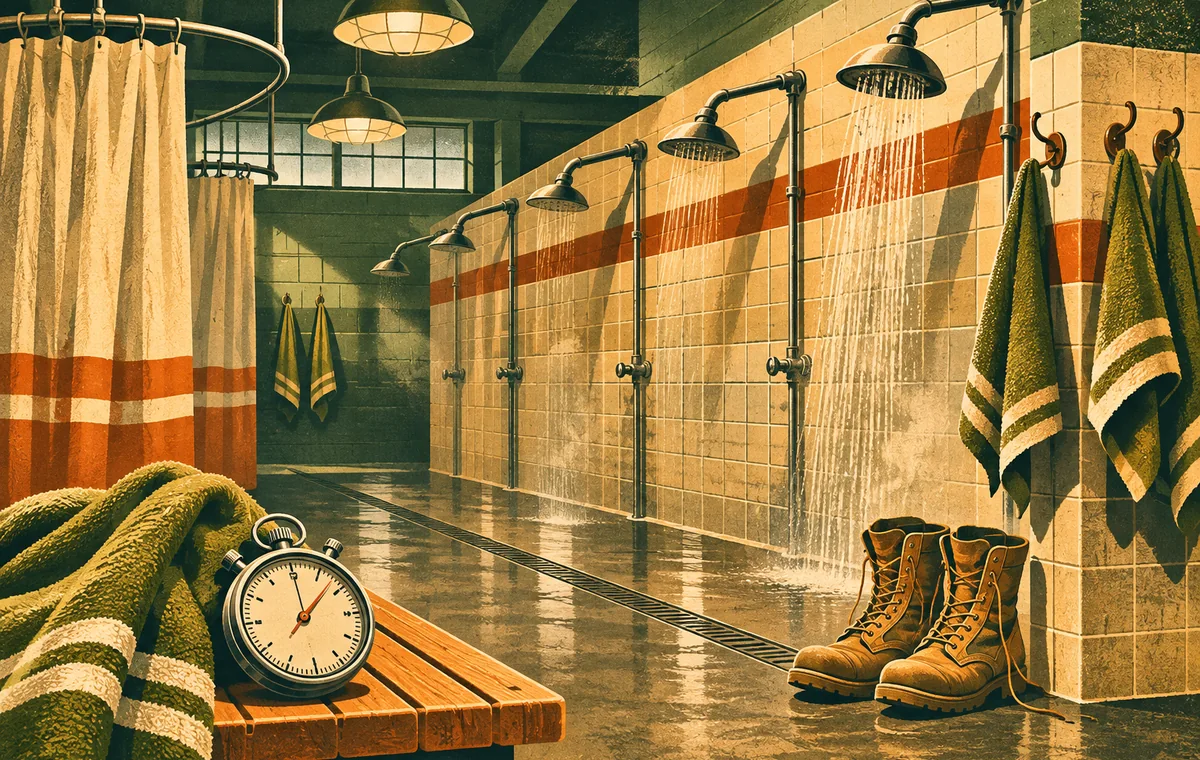
Number of ways the military can make taking a shower feel like a timed administrative exercise: disturbingly many.
Two statistics, because one was not humiliating enough
The submitted report makes one useful distinction. Unique encounters means different people an individual happens to see. Cumulative encounters means all the repeated accidental sightings of the same people. It is the distinction between “how many coworkers are on this floor?” and “how many times has Simmons tried to borrow a towel?”
To use an entirely fictional example, a group of 40 recruits might occupy an open changing area. Someone does not automatically observe all 39 others, and nobody has demonstrated a constant daily “glance rate.” Facility layout, schedules, movement, curtains, individual behavior and the definition of an encounter all matter. Multiply invented probabilities by 70 days and you get a very sophisticated-looking invented number.
Military science has a term for this sort of thing: we should probably not call it science.
The six branches report to the Privacy Logistics Desk
We can compare verified training arrangements and cultural stereotypes, but not measured anatomy totals. Here is the unofficial readiness brief. Every quip below is satire—not a reported average, rating or official judgment.
| Branch | What we can verify | Unofficial dispatch |
|---|---|---|
| Marine Corps | About 13 weeks; a Marine Corps-commissioned study documented hurried communal changing and privacy differences. | “Five minutes to shower, fifteen years to tell the story.” |
| Navy | Recruit training is at Great Lakes. Any exposure depends on actual facility and individual circumstances. | “Ships are built around the idea that square footage is a rumor.” |
| Coast Guard | Eight-week basic training at Cape May. No validated average encounter count. | “Secure the facility, report the weather, locate the curtain.” |
| Army | Standard basic training lasts 10 weeks, and sleeping configurations can differ markedly. | “Your experience may vary; see installation, building and whoever bought the curtains.” |
| Air Force | Basic Military Training lasts 7.5 weeks. Duration alone cannot establish privacy. | “Please open a facility ticket. Estimated response: after graduation.” |
| Space Force | Guardians attend Air Force BMT plus Space Force-specific training. | “We asked orbital command. They referred us to the same shower schedule as everyone else.” |
Anecdotes about specific showers, dormitories and posts should not be generalized to everyone in a branch. An infantry training pipeline and a modern technical-school dorm are not interchangeable settings.
What the impressive-looking original spreadsheet actually says
The research memorandum we were given assigns 74 unique sightings to Marines, 75 to Navy recruits, 80 to Coast Guard recruits, 46 to Army infantry trainees, 39 to standard Army trainees, and 39 each to Air Force and Space Force trainees. Those are values produced by its assumptions; the document does not identify field observations or a representative sample capable of validating them.
It also treats some details—such as percentage probabilities of sightlines by shower architecture, how often a soldier is selected for observation duty, and four-year exposure totals—as if their precision were established. We could not independently verify those percentages or resulting totals. In other words, the spreadsheet is ready for a PowerPoint presentation; it is not yet ready for peer review.
The defensible insight is qualitative: architecture changes privacy. A communal bay, a stall with a curtain and a private room do not offer the same sightlines. Training group sizes and changing schedules matter too. But those relationships are not a substitute for measured sighting counts.
One serious report, one very real rule
A University of Pittsburgh-led study commissioned by the Marine Corps documented hurried hygiene sessions in which recruits changed in squad-bay areas and described inconsistent protections for male and female recruits. That is meaningful evidence about privacy practices, not an estimate of how many penises anybody saw. Privacy is a legitimate quality-of-life issue even when we are being ridiculous about its arithmetic.
Meanwhile, DoD Instruction 1010.16, updated in August 2025, requires direct observation for military urine drug-test specimen collection, subject to privacy measures that do not compromise collection integrity. That is an actual institutional practice. The original memo’s proposed “probability of becoming an observer” and its sweeping four-year totals, however, aren't statistics supplied by that directive.
The humorous lesson: the military has a written procedure for observing a cup being filled, but no published spreadsheet of every accidental communal-shower glimpse. This may be the rare paperwork gap everybody is happy to leave unfilled.
Get your unofficial branch briefing
Choose a service for a nonsense dispatch. This button is a satire generator, not a prediction or data collection instrument.
Official count: unavailable. Unofficial conclusion: bring shower shoes.
The only conclusion this unit will sign
The average varies from person to person and facility to facility, and we do not have defensible data to calculate it by branch. If someone gives you an exact answer ending in three decimal places, ask where the study was published. If they respond “my platoon,” thank them for their service to the national anecdote reserve.
What matters in real life is access to hygiene facilities, reasonable privacy, respectful behavior and enough time to get clean. The funniest part is not somebody’s body. It is the organizational ambition to turn even the most human routine into a timed evolution, complete with instructions, an observer, and a clipboard.
Final unofficial count: unknown. Confidence interval: from “mind your business” to “why are we making a spreadsheet?”
For the companion literary interpretation, visit the Department of Unverified Observations from our unfinished Just Boot Things book.
Source notes & methodology
Primary source descriptions were checked November 3, 2026. The numerical memo supplied for this feature was an unverified modeling exercise; it is not a government study. Illustrated scenes are original editorial artwork, not photos of actual training facilities.
- USMC / University of Pittsburgh, Gender-Integrated Recruit Training Study (2022), pages on hygiene and privacy
- DoD Instruction 1010.16, August 2025 change, Section 4.3 (collection observation)
- U.S. Army: Basic Combat Training overview
- U.S. Air Force: 7.5-week BMT
- Coast Guard: eight-week recruit training
- Space Force: BMT overview
- Marine Corps recruiting: 13-week training
The Bureau expanded its investigation
Our privacy census now has three companion reports: Operation Blue Balls, The Pube Maintenance Crisis, and The Five-Minute Shower Doctrine. Same ridiculous institutional tone; no invented official statistics.