BOOK DESK · BONUS ORIGINAL FICTION / ANNEX A
The Department of Unverified Observations
Bonus original manuscript excerpt: a military research office investigates a number it has absolutely no way to know.
Memorandum for: absolutely no one
Every institution has a department nobody can explain. Some departments process orders. Some oversee procurement. Some exist to find the location of the paperwork requested by the department that lost it. One Tuesday, the barracks acquired a new one: the Department of Unverified Observations.
Its mission was simple. Determine, by branch of the armed services, the exact number of other men a recruit accidentally sees during the unscheduled but somehow fully scheduled ritual of hygiene. Its first order of business was to order a clipboard. Its second was to find a regulation governing the first.
The director, a man who had devoted eighteen years to reducing uncertainty by printing additional copies of it, insisted that the new statistic must be “operationally defensible.” He had no idea what that meant in this context, but he could make it sound like a briefing. He had seen this trick succeed before.
A formula is born
The research team divided the problem into two categories: different people and repeated encounters. It was a beautiful distinction. It allowed two columns where one question had stood.
“How do we know whether the encounter occurred?” a junior analyst asked.
“We apply a visibility coefficient.”
“Where does the coefficient come from?”
“A table.”
“Where does the table come from?”
The director stared at the junior analyst for the first time with the unmistakable expression of a person identifying a threat to institutional productivity.
“You may be misunderstanding the purpose of the table,” he said.
They proceeded to invent the categories of Open Bay, Partial Curtain, Full Curtain, and Curtain That Is Technically Present but Somehow on the Floor. Everyone felt proud. No one had counted anything.
The inspection
The team visited an empty changing area with a stopwatch, a tape measure and the confidence of architects planning a suspension bridge. They measured a bench. They measured a towel hook. They measured the angle of an open locker door. At one point the deputy director stepped backward into a mop bucket, which the minutes recorded as “unexpected field exposure to cleaning operations.”
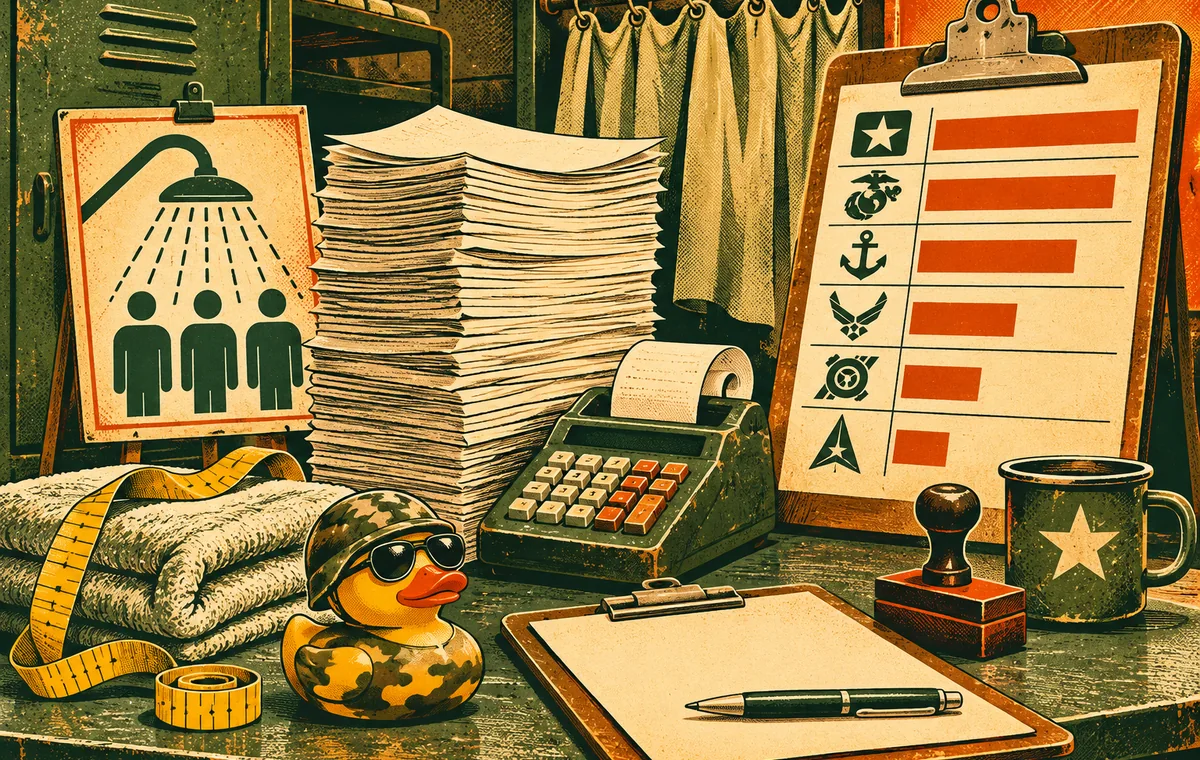
The next day, a PowerPoint appeared. Its headline promised “Precision Through Visibility.” The graph showed six branches and forty-seven bars. The Army had twelve shades of green. The Marine Corps had a new classification called “maximum institutional togetherness.” The Navy requested that the word “head” not be used without a footnote. The Space Force asked why it was in this briefing at all.
Of the 47 bars, not one represented a measured average.
The final finding
A week later the director announced his conclusion.
“We can calculate almost anything,” he said, “provided we are willing to assume nearly everything.”
This caused a long silence, not because it was profound but because everyone had been waiting for lunch since 1045.
To its credit, the department eventually produced one defensible line: privacy depends on the facility, and a good institution should take it seriously. This line did not require a 47-bar chart, a branch rivalry or the physical inventory of strangers. The director found it unsatisfying and made the font larger.
It was published as Annex A, stamped UNOFFICIAL, and filed behind the requisition for additional shower curtains. Someone took the last working pen. The Department of Unverified Observations remained undefeated.