DEPARTMENT OF UNNECESSARY MILITARY STATISTICS · FIELD REPORT 011
The Tactical Ball Sweat Index: When PT Shorts Become a Weather System
A serious-sounding investigation into humidity, ruck marches, chafing and the least ventilated real estate in the armed forces.
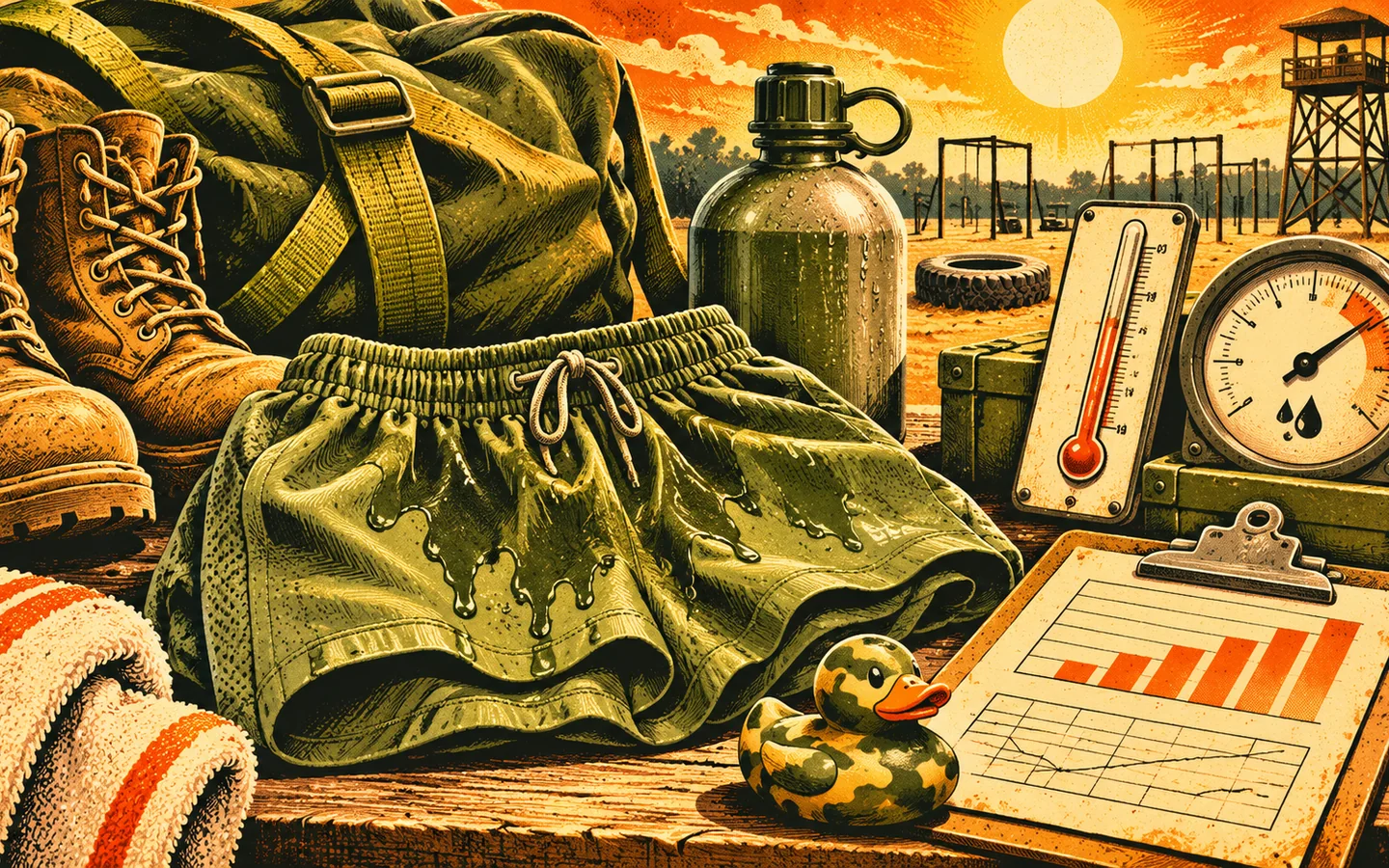
The heat index nobody puts on a range card
The Department of Unnecessary Military Statistics would like to announce the discovery of a microclimate. It occupies very little land, has no runway, and is nevertheless affected by every military training exercise undertaken south of the Mason-Dixon line. It is located exactly where the uniform manufacturer insists two pant legs should meet.
Imagine a recruit at 0545, still optimistic about the day, dressed in fresh PT gear. By 0605 the optimism is gone. By 0630 the shorts have filed a declaration of independence from the concept of dryness. A drill instructor is discussing discipline while the recruit is quietly conducting the first recorded study of whether a man can perspire directly through his personality.
What the real research supports
Heat, humidity, heavy gear and prolonged physical exertion can strain the body during training. The Defense Centers for Public Health identifies outdoor training heat risk, and medical researchers have found that marches and runs are important contexts for exertional heat illness. Those are real training-safety issues, not merely invitations to complain about sweaty underpants.
Chafing is a different but related problem. Cleveland Clinic describes repeated friction between skin, clothing, and moist surfaces. Sweat and poorly fitting garments can make it worse. That means friction around the inner thigh or groin can be painful even when there is no dramatic injury, no dramatic obstacle, and absolutely no dramatic speech to deliver about it.
Neither source publishes an official military “Ball Sweat Index.” The Department does not have a climate-monitoring station in anyone’s shorts. We have a clipboard, an exaggerated sense of duty and an unwillingness to leave this topic alone.
The Army can calculate wind chill, but what about crotch chill?
In the Department’s imaginary test protocol, a volunteer reports temperature, humidity, training duration and the amount of fabric pressing against the inner thigh. The researcher then writes the result in bold red ink, announces an operational condition and informs everyone that the equation was peer-reviewed by a rubber duck.
At low values, the fictional system displays “Dry Dock.” At medium values, “Moist Contact.” At high values, “Swamp Operations.” These are comic labels, not medical severity categories. A low joke-score is no guarantee against heat illness, and a high one is not a diagnosis.
This is a useful place for practical humility: clothing that stays wet, rubs continuously or fits badly may need to be adjusted, cleaned or changed when the training schedule and local rules allow. Significant heat symptoms require prompt attention under the actual safety program, not a website widget.
How the humble underwear change became a field maneuver
One dry pair can make a larger difference to morale than another inspirational speech. The obstacle is that boot camp does not give every recruit complete freedom over packing, clothing or laundry schedules. Unit guidance controls what gear may be brought or worn, so our advice is not “buy an exotic twelve-layer tactical garment and hope a drill instructor loves it.”
Instead: follow the current packing list; keep permitted clothing clean and dry when possible; mention persistent rash or skin breakdown to medical staff; and do not mistake embarrassment for a reason to suffer quietly. We are talking about skin, not an honor test.
If the Department could authorize one new piece of equipment, it would be a moisture-wicking PowerPoint slide. It would not help the situation, but somebody could wear it over the actual PowerPoint presentation.
The entirely unofficial verdict
Our fictional headquarters has rated the crotch climate of boot camp as “a strategically humid region requiring sustained attention.” A flag officer objects that no such area is on the map. The quartermaster quietly asks whether it needs a separate supply line.
The final field finding is simple: sweat is ordinary, friction is real, and severe heat illness is never funny. The fact that a recruit can explain all of this while standing at attention in shorts that have become a regional weather pattern, however, is extremely funny.
Try the Tactical Ball Comfort Simulator for a deliberately imaginary readiness score. Then remember that the Department is fictional and your skin is not.
Sources for the factual portions
These references substantiate specific equipment, safety or physiology statements—not our invented statistics or comic dialogue.
More from the Balls Bureau
The Tactical Ball Sweat Index: When PT Shorts Become a Weather System · Government-Issued Underwear: The Pentagon’s Most Sensitive Procurement Decision · The Rope Climb vs. the Family Jewels: An Unofficial Ballistics Report · Cold-Shower Shrinkage: The Smallest Operational Readiness Crisis
The Balls Bureau ↗ · The Penis Census ↗ · Operation Blue Balls ↗ · The Biggest Guy in the Shower ↗