DEPARTMENT OF UNNECESSARY MILITARY STATISTICS · FIELD REPORT 011
Government-Issued Underwear: The Pentagon’s Most Sensitive Procurement Decision
The military can buy aircraft carriers. Can it also procure underpants that do not start an argument with your thighs?
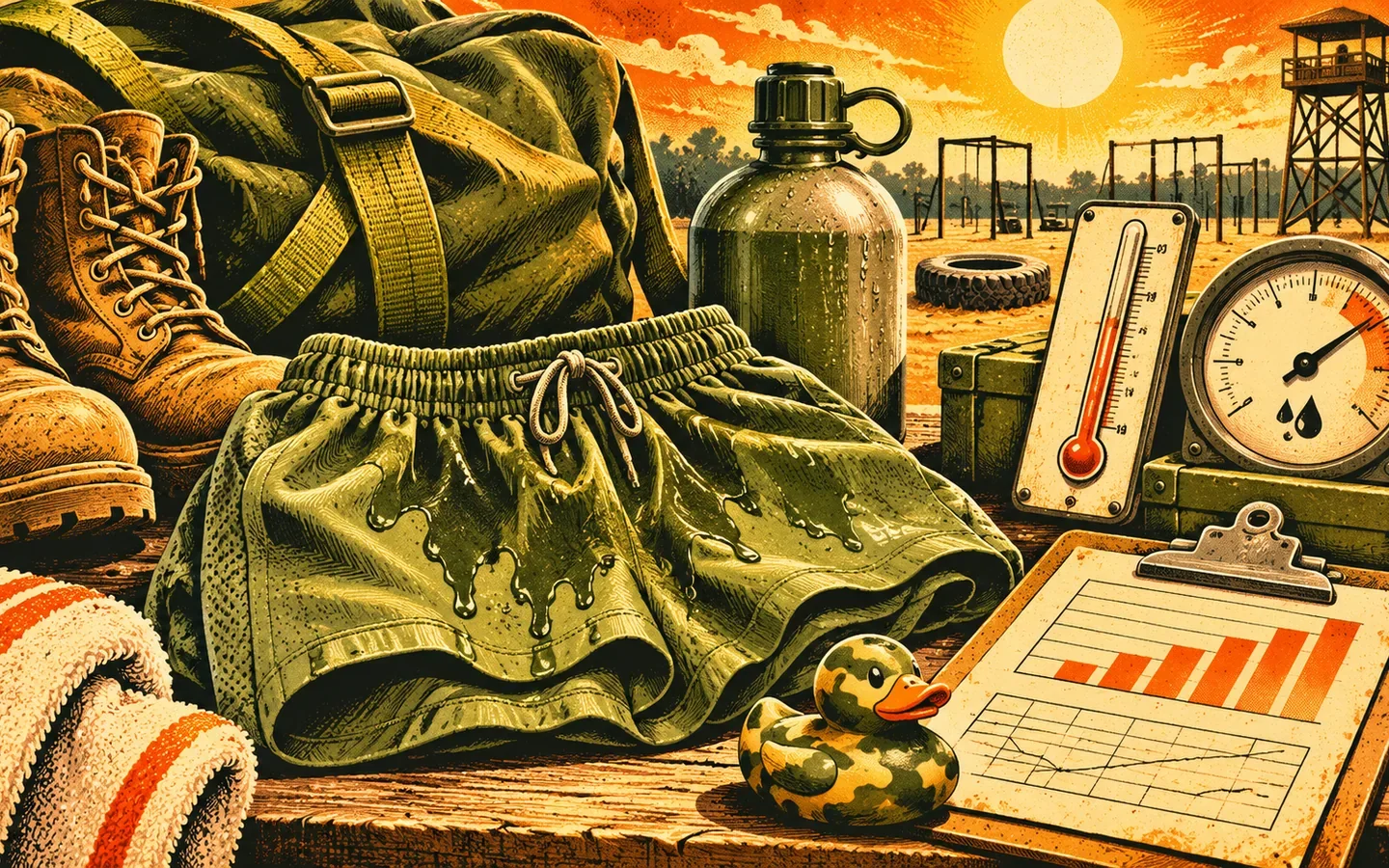
The most personal line item in the military budget
On an ordinary first day of military training, a recruit may encounter a startling sequence of government-owned objects: boots, uniforms, bedding, inspection forms, identification cards and several people authorized to tell the recruit exactly how to fold things. Eventually, the procurement system approaches the only item of equipment a recruit has trusted with his future family plans.
Underwear is a humble object with an ambitious mission statement: remain invisible, stay in position, avoid friction and prevent the entire day from becoming about underwear. Any failure is instantly memorable. The Department of Unnecessary Military Statistics believes this qualifies as national-security-adjacent.
Yes, the government really has an underwear supply chain
The Defense Logistics Agency says its Clothing and Textiles program provides basic recruit items—including undergarments—to Army, Navy, Marine Corps and Air Force training centers. This is not a joke added to the article for color. There are genuine warehouses, inventories and distribution systems behind those astonishingly unglamorous objects.
Government Accountability Office reporting likewise describes underwear among initial-training clothing-bag items. The Army’s public joining instructions list three sets of white cotton underwear to bring, though the exact current recruit packing list is the controlling authority and individual branches differ.
None of those sources establishes a universal military requirement that every recruit wear the same cut, fabric or brand forever. Nor does it prove that one pair is “the worst in military history.” That claim is reserved for whichever pair rides up during a long run.
The great boxer-versus-briefs strategic debate
Imagine our fictional Acquisition Review Board seated behind a conference table. On one side is the Team Freedom of Movement. On the other is the Task Force for Structural Support. Both insist national readiness depends on their preferred fabric geometry.
An experimental apparatus is proposed: a treadmill, a fabric friction meter and a volunteer who did not read the consent form carefully enough. Eight hours later the board has produced 46 slides and no decision. The quartermaster asks why they cannot just issue clothes that fit. The quartermaster is immediately promoted out of the room.
The actual practical questions are less theatrical: does the undergarment fit without constant rubbing? Does it dry appropriately? Does it comply with the local packing and uniform requirements? Can the recruit obtain a permitted replacement if it tears or does not fit?
“It is one size too small” is a problem, not a character flaw
Skin-on-fabric rubbing can lead to chafing, especially in warm, wet conditions. Repeating a workout in a garment that is already irritating the skin can make it worse. Medical care may be appropriate if the skin is broken, infected, not improving or the pain seems unrelated to simple friction.
For recruit families, the biggest lesson is not to mail a surprise box of elaborate performance underwear to basic training. Check the unit rules first. A care package that violates the rules becomes a whole second article in this very publication.
For recruits, the lesson is to report fit problems through the available uniform and medical channels. There is no medal for losing a fight with a seam.
A procurement recommendation from our imaginary committee
Our Department proposes a new official test: have the procurement officers wear the proposed underwear during a full day of formations, a ruck march, and one surprise inspection of a room they just cleaned. Afterward, nobody may write “meets specifications” until they can walk normally.
The test will never be authorized. The report will be expensive. The conclusion will still be “fit matters.” Somewhere, a binder will be stamped “CLOSEOUT COMPLETE.”
In the meantime, the least dramatic outcome remains the goal: underwear so unremarkable that the person wearing it spends the day worrying about normal military things, like whether the trash can is permitted to contain trash.
Sources for the factual portions
These references substantiate specific equipment, safety or physiology statements—not our invented statistics or comic dialogue.
More from the Balls Bureau
The Tactical Ball Sweat Index: When PT Shorts Become a Weather System · Government-Issued Underwear: The Pentagon’s Most Sensitive Procurement Decision · The Rope Climb vs. the Family Jewels: An Unofficial Ballistics Report · Cold-Shower Shrinkage: The Smallest Operational Readiness Crisis
The Balls Bureau ↗ · The Penis Census ↗ · Operation Blue Balls ↗ · The Biggest Guy in the Shower ↗