BARRACKS LIFE / UNOFFICIAL FIELD REPORT
The Biggest Guy in the Shower: An Unofficial Field Report
A brief encounter with an unexpected statistical outlier, followed by a surprisingly long career in pretending nothing happened.
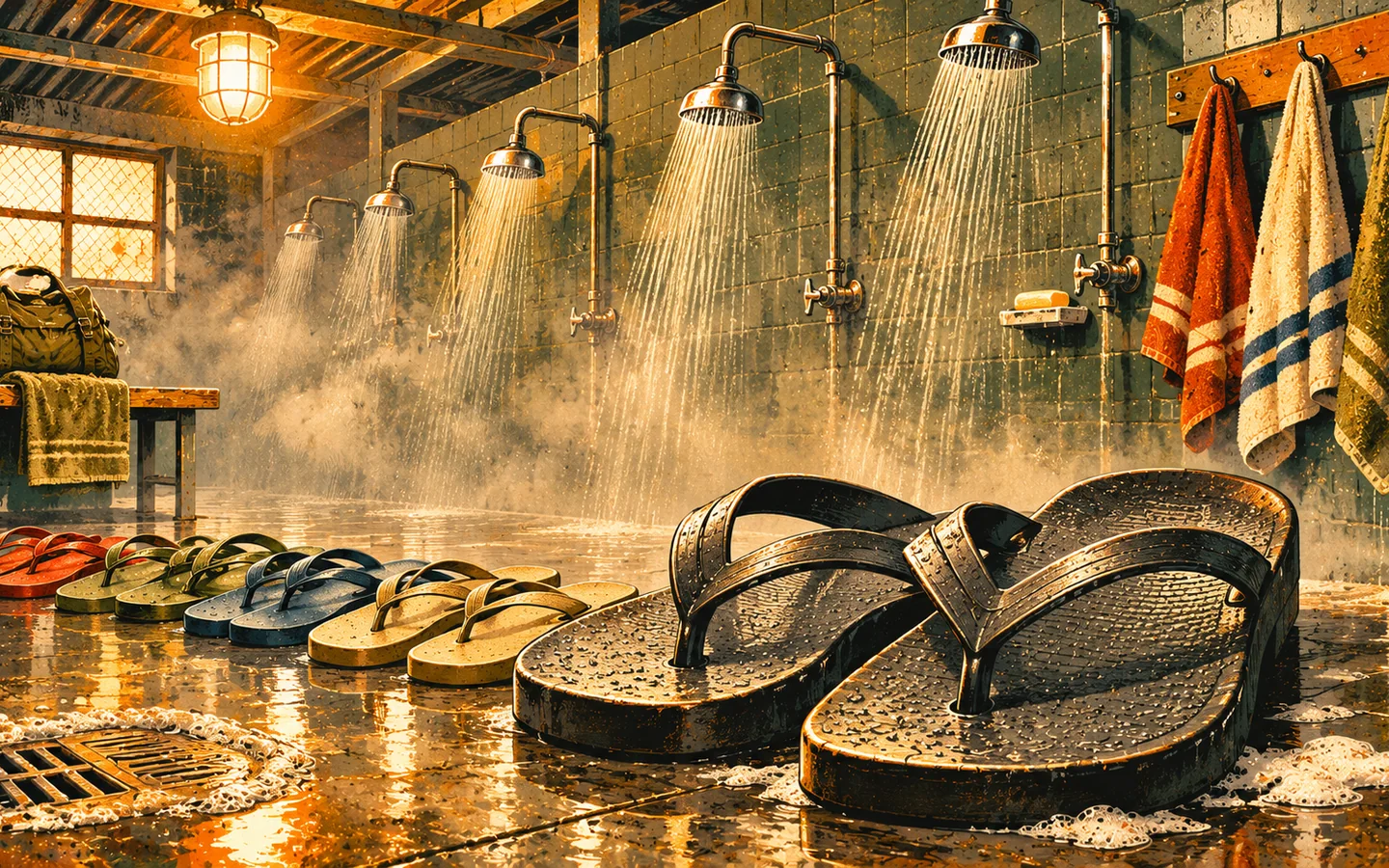
The day the standard deviation resigned
You arrive at the communal shower with three priorities: locate a functioning showerhead, keep track of your soap, and get out before someone decides the whole platoon needs a second briefing about the importance of speed.
Then, somewhere within the normal visual chaos of wet tile, steam, and thirty exhausted adults moving on tight schedules, your brain registers an unexpected statistical outlier.
For perhaps half a second, the mathematician inside your skull tries to open Excel. The rest of your nervous system files an immediate request to return to the original mission: wash, rinse, leave. Your face makes the expression normally reserved for discovering that the mess hall has run out of coffee.
And in that fleeting moment, a man you will never exchange a substantive word with becomes the unwitting subject of an imaginary Pentagon briefing titled “Unexpected Variance in Personal Equipment.”
Why communal showers make everyone temporarily weird
Boot camp does not usually give people the relaxed, private routine they recognize at home. In the Marine Corps' commissioned recruit-training study, investigators described tightly structured hygiene periods, recruits undressing and redressing near their racks, and inconsistent privacy practices in the training environment. That supports an observation about limited privacy, not a branch-wide census of anatomy.
Public anecdotes from former recruits, including a discussion of Marine Corps recruit showers, emphasize two recurring experiences: the initial awkwardness passes quickly, and there is generally much less time to look around than an outsider might imagine. These anonymous posts aren't representative data.
One important caveat: open shower bays are not universal across all services, installations or decades. The room in this story is a fictional composite, and its inhabitants are adults. There is no credible official database of recruit anatomy and no reason for one to exist.
The legendary five stages of shower intelligence
- Detection: a completely involuntary “huh” from the pattern-recognition department.
- Denial: the brain announces that it was probably a trick of the lighting.
- Administrative review: an internal committee demands a second look. The chair immediately denies the request for lack of mission necessity.
- Return to duty: soap is located. Shampoo is applied. Somebody loudly announces the time remaining.
- Post-incident report: absolutely nothing is written down, which is the healthiest outcome for everybody.
The comedy is your own embarrassed impulse to compare people, not somebody else's body. At no point is the other man obligated to become a public attraction, a punchline or a legend. He is also trying to find his towel.
The Department proposes an Unsolicited Comparative Readiness Board
Our fictional research office immediately proposes several measurements: subjective surprise, time-to-resume-showering, towel-recovery time, and likelihood of ever mentioning the incident again. All receive a score of “Not Our Business.”
A proposed budget of $3.6 million would purchase two waterproof clipboards, an assistant statistician and exactly one poster reminding everyone to stop conducting unauthorized field research in a bathroom. The appropriation is denied. The poster is approved.
There is also no meaningful evidence that every platoon has a single obvious “biggest guy,” nor that anyone would agree on a definition. Human anatomy varies, perception is unreliable, and nobody signed up for a competitive assessment. That uncertainty is the reason the Department has classified the project as “Operationally Irrelevant but Socially Memorable.”
What actually happens after the surprise
Usually? Nothing. People adapt to shared facilities, focus on the schedule, and discover that nearly everyone has more important worries. Somebody's soap falls. Someone else has the world's loudest flip-flops. A third person is still trying to work out whose towel is whose.
You'll remember how strange the room felt when you first entered it. You will eventually stop thinking about it at all. And one day, years later, you may tell the story in sanitized form: “Boot camp was a real education in minding your own business.”
That's the Department's final finding. The most important piece of equipment in the shower is not a measuring device. It is the ability to treat other people with basic dignity while getting on with the task at hand.
Final classification: Awkward for three seconds; ordinary for everybody else; never worth a PowerPoint.
More Uncomfortable Logistics investigations →
Sources & editorial boundaries
Official records establish policies and training context. Community discussions are anecdotal. Editorial archetypes, jokes and invented offices are not empirical findings.
More awkward field reports
Boot Ink hub · Before-boot tattoo guide · Tattoo archetypes · The shower outlier · The Penis Census · Five-Minute Shower Doctrine