THE DEPARTMENT · PASS 12 · FIELD REPORT 012
The MEPS Cough Test: Your Balls’ First Military Inspection
The oddest part of a serious medical screening: a few seconds, one awkward cough, and the sudden realization that military paperwork has become personal.
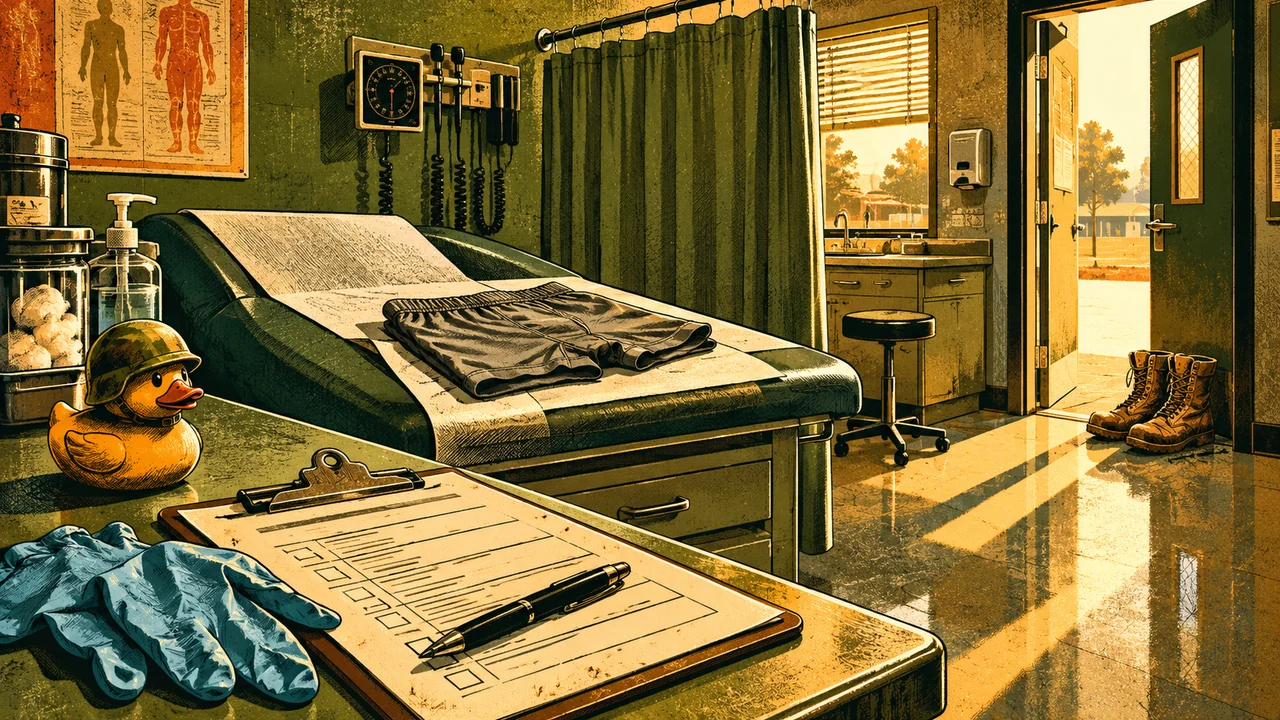
Welcome to the least glamorous job interview
The recruiter has described opportunity, education, discipline, travel, teamwork, and perhaps a career with a substantial amount of expensive equipment. Then the applicant reaches the military entrance processing station. Suddenly the main question is whether your body can satisfy a medical checklist that appears to have been written by someone suspicious of every organ.
There is a physical exam for a reason. Military training can be demanding, and medical problems deserve to be identified before they become a worse problem in the field. Still, nothing prepares a hopeful future warrior for the combination of fluorescent lights, paperwork, unfamiliar instructions, and a provider who needs you to cough while checking for a hernia.
Our entirely fictional Department of Unnecessary Military Statistics has designated this “the first ball inspection of military service.” Its official motto: We have checked the equipment; proceed to the next window.
What the real screening does — and what it does not
An accession medical exam can include review of medical history, general physical assessment, and checks for conditions such as hernias. The exact steps depend on the applicant and the applicable examination procedures; this is not an independent anatomy contest or a ritual designed for entertainment.
MEPS examination rules address privacy, applicant consent, and chaperones. The applicant or provider can request a chaperone under the published framework, and the procedure must follow medical rules rather than whatever a veteran's cousin claims happened in 1998. If you have a concern about the examination, raise it with the medical staff.
The “underwear Olympics” stories you hear are partly about the awkwardness of an unfamiliar institutional medical environment. They do not establish that sensitive examinations are performed as a public spectator sport.
The cough that launched a thousand rumors
Why cough? An examiner may ask for a cough or strain during a hernia check because increasing abdominal pressure can help make an abnormal bulge detectable. It is a brief clinical maneuver, not a measure of courage, masculinity, or whether you can follow orders without laughing.
In our fictional report, the applicant prepares like an athlete on the starting line. He coughs once, worries that it was not sufficiently authoritative, then considers asking for a second attempt. The provider checks a box and moves on. The entire emotional drama exists in the applicant's head.
The administrative office would like to remind everyone that a successful cough does not qualify anyone for a combat badge.
The privacy question matters
This is the section where we stop joking for a moment. You may ask what an examination is for, what will happen next, and whether a chaperone is available. Medical screening is not consent to ridicule or unnecessary exposure.
Likewise, disclose relevant symptoms and prior conditions accurately. Trying to conceal a potentially serious problem just to avoid an embarrassing conversation is not strategic. It may place you or others at risk when training begins.
If you experience persistent pain, a new lump, swelling, or an unfamiliar change, seek healthcare rather than waiting for a joke website to issue a clearance decision.
The Department’s final finding
The MEPS cough test is memorable because it compresses the entire enlistment experience into one odd little scene: there's a rule, a line, a form, a medical purpose, and a human being wondering whether he looks foolish. He probably does; everyone does at some point.
A decade later he may remember the medical evaluation more vividly than the recruiter’s presentation about benefits. The lesson is not that the process is ridiculous. The lesson is that the human brain can make a 20-second medical check feel like a major episode in military history.
Field finding: keep your paperwork honest, ask questions when needed, and remember that the examiner has encountered much stranger days than yours.
Source notes and corrections
These references support the factual points described. They do not establish our invented scenes or metrics. Training procedures change: confirm current unit guidance directly.
- USMEPCOM Regulation 40-1 — examination consent, privacy and chaperones
- Defense Health Agency — accession medical standards
See our editorial standards and contact the editors with corrections.