Three Questions the Recruiting Poster Forgot
A field manual for those brave enough to ask what happens between “lights out” and “get in formation.”
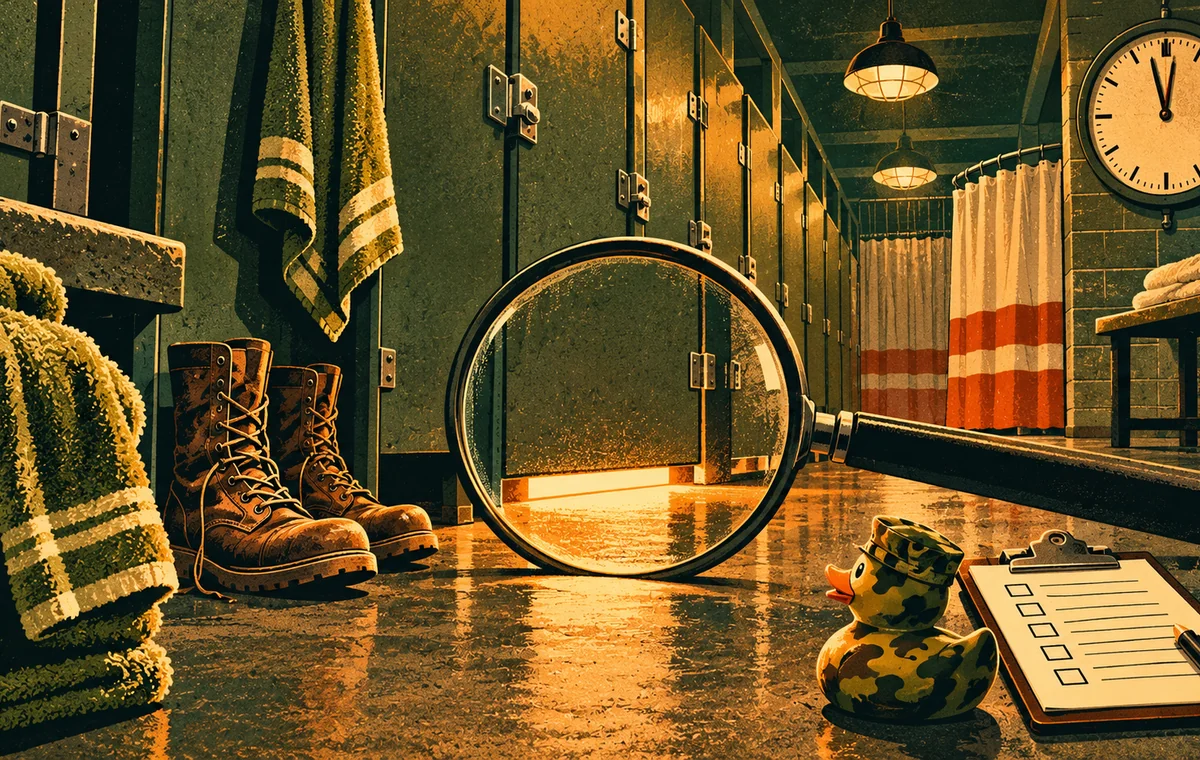
Memo to all recruits: You will be issued uniforms, bedding, a training schedule, and a vocabulary in which normal activities acquire the title “operations.” You will not, however, be issued a reliable answer to certain questions about bodies, bathrooms and personal time. The Department of Unnecessary Military Statistics has therefore established the following three offices.
Office One: The Bureau of Uninterrupted Minutes
The Bureau's headquarters consists of one chair outside a bathroom door. Its entire operating budget is a wristwatch with a cracked face. Its mission is to determine whether any recruit can experience a moment alone without someone else appearing to require an update, a cleaning supply, or an emergency decision about how many towels belong on the shelf.
Officer Peterson was made the bureau chief because he had once successfully hidden behind a supply-room door for twelve seconds while searching for a broom. His appointment was celebrated at a formation attended by thirty-five people who had been told to arrive early. During the ceremony, the commanding officer spoke for nineteen minutes about initiative. The Bureau then lost access to its chair because someone needed it for a briefing.
Its first experiment was elegant: place a perfectly ordinary door in the barracks and ask whether it could remain closed for five minutes. Two minutes later a corporal knocked to ask whether the room was occupied. A minute later another corporal knocked to find the first. The door's privacy rating was downgraded to “theoretical.”
Office Two: The Directorate of Strategic Landscaping
This office was created after a junior recruit misread a line about “grooming standards” and asked the sort of follow-up question that makes an entire room suddenly interested in its shoelaces. Nobody could produce the relevant section of the manual. A senior member of staff suggested “use common sense,” a phrase so operationally vague it was immediately placed under review.
The Directorate studied the humble shaving kit. The kit contained a razor, a brush, a tube of something foamy, and the implied confidence that the recruit would have time to use them. Investigators discovered that the best way to preserve a shaving kit was to keep it clean, use one's own equipment, and decline the temptation to turn optional personal grooming into another mandatory shared-room event.
After three meetings, the office unanimously recommended that intimate grooming decisions remain private. Someone proposed issuing a badge for the recommendation, but even the Department decided that would be too much.
Office Three: Shower Bay Operations Command
Shower Bay Operations Command was the only office in the building with running water. It was also the only office operating under the suspicion that time might be finite. Its chief engineer was handed a floor plan, a list of recruits, the number of functional showerheads, and a rumor that everyone could be finished in five minutes.
He did the multiplication. His calculator displayed a number that was noticeably larger than five. The room grew quiet. The major asked him to do the multiplication again with more motivation.
They tried scheduling the recruits in waves. They tried scheduling the waves in smaller waves. They tried a technique called “synergy,” which mostly involved drawing a second arrow on the diagram. Finally, the engineer pointed to the regulation calling for an uninterrupted shower and noted that a human body was not a vehicle passing through an automated car wash.
The office's final report was two sentences: “A showerhead can accommodate only a limited number of people at a time. Please stop arguing with arithmetic.” It was returned for revision because it lacked a cover sheet.
Departmental conclusion
Modern armed forces spend enormous effort making crowded institutions function safely and effectively. Human beings, however, remain stubbornly human: they need sleep, privacy, clean facilities and the occasional minute without an announcement. When the logistics fail, humor is one way to describe the absurdity without pretending the needs themselves are silly.
The Department has closed all three investigations. A fourth investigation, concerning who has been taking the nice pens, has unfortunately been postponed because nobody can find a pen.